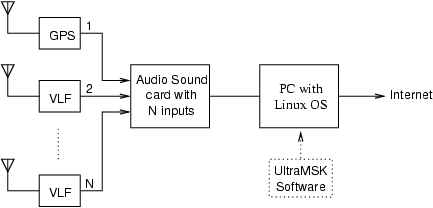
UltraMSK is a software application that measures the phase and amplitude of narrowband VLF radio signals. The software runs under the Linux operating system. Most of the main Linux distribution families e.g. Debian, Ubuntu, RedHat, CentOS, Rocky, Fedora etc. are suitable to use. You will need a GNSS/GPS receiver with a 1PPS output signal, a VLF radio receiver and a computer with a sound card. The computer hardware requirements for UltraMSK are modest and similar to that for running the Linux OS itself. It is also possible to use small single-board computers such as the Raspberry Pi.
Please feel free to contact us should you have any questions about what is needed to get an UltraMSK receiver up and running. A free evaluation of the software is available on request.
Sound Card
UltraMSK makes use of standard audio sound cards for data acquisition. You will need a sound card with enough input channels to connect each of your VLF antenna signals plus one additional channel to input the GPS 1 PPS signal. For a single vertical electric field antenna, a standard 2 input channel sound card would be sufficient. Whilst for a setup with orthogonal VLF loop antennas, a multichannel audio interface would be required. The sound card must be capable of sampling at either 48 kHz or 96 kHz and must use sigma-delta analog to digital converters. Many computer motherboards have a built in sound card which may be suitable. Or separate PCI-e sound cards can be used. Suitable multichannel sound cards include USB audio interfaces such as the Focusrite Scarlett range or products from Behringer are another option to consider. UltraMSK uses ALSA or the VLF Software Receiver Toolkit for data acquisition from the sound card.
GPS receiver
A GPS receiver with a precision 1 pulse per second (PPS) output is required. The 1 PPS signal is connected to an input channel of the sound card. The width of the 1 PPS pulse must be either less than or equal to 10 microseconds or else wider than 1 millisecond.
For accurate signal timing, the PC clock must be set to within +/- 500 milliseconds of UTC. This can be achieved using the Network Time Protocol.
VLF radio receiver
You will need to provide a VLF radio receiver i.e. antenna, preamplifier and power supply. You can use electric field whip antennas or magnetic field loop antennas. The signal needs to be preamplified up to a line level suitable for connection to your sound card.